
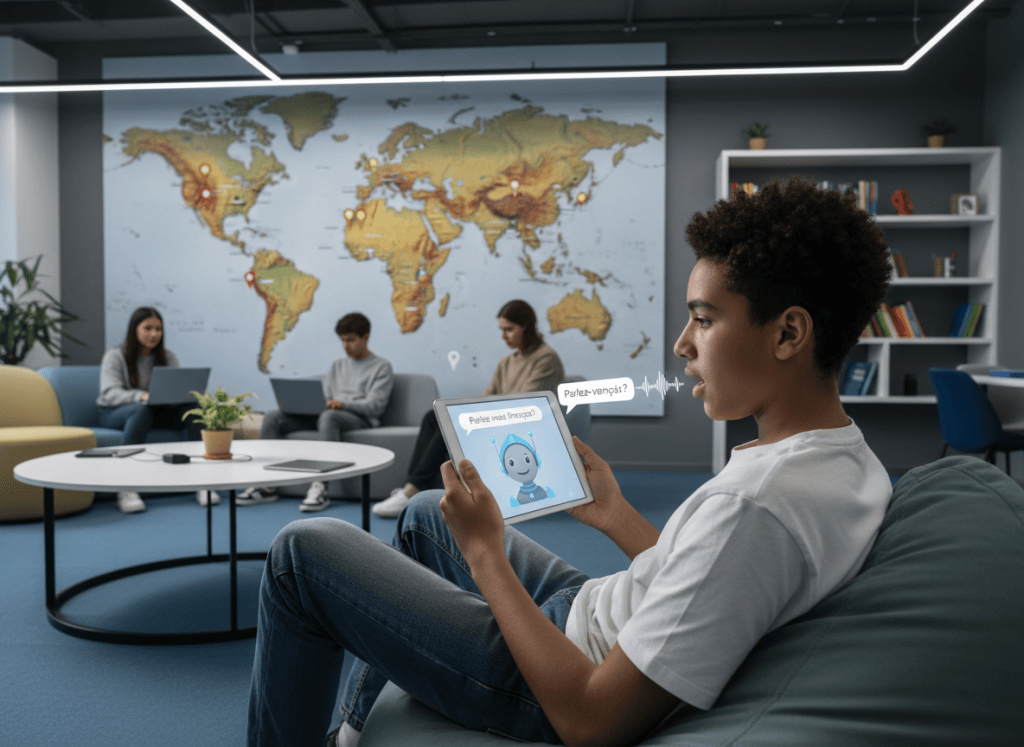
If you feel like new AI language tools are popping up faster than your child can say “hello” in Spanish, you’re not imagining it. Over the past year, language learning has become one of AI’s favorite playgrounds—and parents are understandably wondering what this means for their children.
In April 2025, Duolingo announced 148 AI-created courses, sparking both excitement and concern about quality and the role of human teachers. Babbel followed with Babbel Speak in September 2025, an AI voice feature that lets learners practice pronunciation on demand. The British Council launched AiBC, a “human-first AI engine,” in October 2025. And in early 2026, Le Monde reported that, despite the AI wave, interest in foreign language learning remains as strong as ever—especially for children and teens.
So where does this leave parents trying to make smart choices for their children? Should you hand your child an app and call it a day, or is a real teacher still worth it?
What AI Language Apps Are Genuinely Good At
Used wisely, AI tools can be a powerful part of your child’s language toolbox. They excel at:
- Repetition without complaint. Apps will cheerfully drill vocabulary and grammar as many times as needed—no eye-rolling included.
- Instant feedback on pronunciation. Tools like Babbel Speak can help children hear and correct mistakes in real time.
- Flexible practice. A quick session in the car or between activities keeps the language “warm” between classes.
- Gamified motivation. Streaks, badges, and cute characters can nudge reluctant learners to log in more often.
Platforms like Preply capture this balance nicely when they describe themselves as “human-led, AI-enabled.” The message is clear: AI is a helpful assistant—but it’s not the teacher.
What AI Still Can’t Do For Your Child
Despite rapid progress, AI language apps have real limits, especially for young learners:
- Nuance and real conversation. True fluency means handling jokes, misunderstandings, interruptions, and emotions—the messy, human side of communication.
- Deep cultural context. AI can explain customs, but it can’t share lived experience, personal stories, or the subtle “feel” of a culture.
- Motivation and confidence. Children don’t just need correction; they need encouragement, humor, and a patient adult who notices when they’re tired or anxious.
- Adaptation in real time. A qualified teacher can change the lesson on the spot, follow a child’s curiosity, or gently challenge them when they’re ready for more.
In other words, AI can help your child practice the pieces of a language. A human teacher helps them put those pieces together into a living, breathing skill.
Why Real Teachers Still Matter—Especially at USA Heritage Academy
At USA Heritage Academy, we welcome smart use of AI for extra practice. But our English language courses are built around something no app can replace: real relationships with experienced teachers.
Our teachers don’t just correct grammar; they listen to your child’s ideas, help them find their voice in English, and create a safe space to make mistakes and grow. They bring cultural context, humor, and real conversation into every lesson—while recommending age-appropriate digital practice to reinforce what happens in class.
If you want your child to do more than tap answers on a screen—if you want them to think, laugh, question, and truly connect in English—a human teacher is not optional. It’s the secret ingredient.
Curious about the full picture? Read about the advantages of a US diploma for European students or explore our approach to online independent learning.


Leave a Reply